Tuesday, April 15, 2014

Wildlife Pond Build Continues and Leads to an Early Bath...

Hello All,

Once again time has got the better of me! But I have been out making the most of the good early sunny hot weather. It certainly beats all the wet weather that we had over the winter time and it's not only me who's been out enjoying the weather but the wildlife also, which is once again starting to wake up in the garden.

To pick up where we left off on the last post I will continue to guide you trough my main project at the moment which is of course my wildlife pond build....

On the last post we left the build just as we had finished excavating the actual pond. Being for wildlife the pond doesn't need to be to deep but I still like to have an area somewhere in the pond that is at least two foot deep, this deeper water gives a safe area for insects and amphibians to over-winter in if we should get cold winters. In a wildlife pond you wouldn't generally keep fish but I will mention here that if you do build a pond with the intention of keeping fish then the pond should be at least three foot deep. My own opinion is that it should be at least four foot in some places for fish keeping.

So here we go then....

Once excavated I crawl around inside the pond and remove any stones or roots that I can see and which could potentially puncture the liner. 

There are various types of liner and my first choice would normally be EPDM  which is a tough lining material with all the attributes of a butyl rubber liner but at less cost. Unfortunately current finances meant that I couldn't afford EPDM and I've opted for a PVC liner of a good quality. To help protect it I have also purchased a good quality pond liner underlay...

Once the layer of sand about half to one inch thick has been added around the whole pond and firmed in I add the underlay ensuring that it overlaps well where there are joins. I attempt to get a minimum of two thicknesses across the whole pond area.....

Now it's time for the liner but prior to fitting it pays to lay it out flat on the lawn in the sun, this warms the liner up and makes it more pliable and therefore easier to mold into place....
I actually laid this liner on my own but it does pay to have a few people on standby ready to help!!

Then run a hose into the pond and let it gradually fill up. Whilst this is happening you must be present to neatly fold and neaten creases as the liner molds around the contours in the pond. If you don't get it neat now then you won't be able to make adjustment once filled as the weight of the water won't allow you to change how the liner lays...
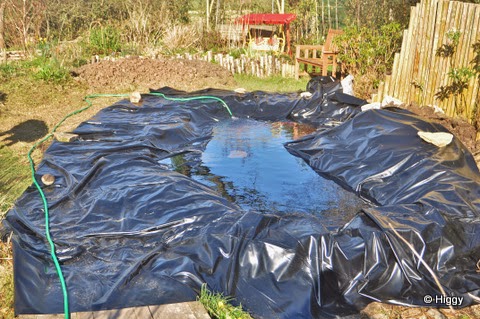
Trim around the edges but be careful to leave a good overlay as when fully filled the water could still pull down the liner a bit more...

Now you are ready to start thinking about the landscaping around the pond and how to hide the edges of the liner....

I decided to add a bridge and this was simply added by concreting some wood into footings on each side of the pond and then once dry screwing some 3"x3" posts across them as below...
This simple bridge was made out of some old fence posts and now creates a walkway to the seating pod...

I decided to hide the edges of the pond by putting large rocks on the upper shelf and then back-filling the space behind with a mixture of clay soil and fine gravel. This makes the perfect planting medium for your marginal plants....  
Note that I re-used the clay from the excavation and mixed it 50/50 with fine grit, this is perfectly OK to do and will save you a lot f money over buying unnecessary pond compost.....

So here is the pond once the marginal landscaping was finished...

At one end I have included a shallow beach area that allows easy entry / exit to wildlife to safely use the pond. This is especially important if Hedgehogs fall in the pond to ensure they can get out....

As if giving this new feature it's seal of approval my resident Blackbird has taken over the job as security guard for the pond and uses it at least twice a day for his morning and afternoon bath!!!!....


Although I have already started planting a few wildflowers around the pond and preparing areas to put back to wildflowers and make up for the lost area from creating this new feature, I will leave this update until my next post. This should give plenty of space to give you the names and pictures of the plants that I intend growing to attract all of our beloved pollinators and of course in the hope of attracting a few more new species into the garden!

This just leaves my usual round up of what wildlife we have been seeing in the garden over the last few weeks.... 

Sticking with the pond theme what about this magnificent Great Diving Beetle - Dytiscus marginalus. A first for the new pond and a first for the garden!!... 

I make no apologies for posting up another 7-spot Ladybird as they are so numerous in the garden which is great!!...

Although common a new recording for the garden was this Bee Fly - Bombylius major
Another new record, Sloe Bug - Dolycoris baccarum....
 Not a new hoverfly for us but welcome none the less was this Syrphus vitripennis

It has been a great year for us in terms of birds, not new species but great numbers of our regular birds with the highlight for me the continued daily presence of our Reed Buntings - Emberiza schoeniclus.....

These green / blue beetles are called Chrysomelidae Alticinae and were in good numbers and breeding in the garden last month.... 

Finally it is absolutely brilliant to see the return of our hedgehogs and they are actively feeding in the garden and seem especially partial to my dry meal worms that I put out for the birds! 

Hedgehogs are in serious decline so I'm really pleased to have the back in the garden again. I'm hoping that my hedgehog houses have helped by giving them a safe warm place to overwinter in. I can't check the boxes as they are buried under the hedges in the garden to provide safety and extra warmth for any hedgehogs that are using them but live in hope that they have helped.

Despite having posted my plans for a home built hedgehog house on Facebook recently, here they are again for anyone else who wants to help save our hedgehogs by providing shelter in their own garden....


So that's it for now, next time I will update you on the planting in and around the pond which will include my wildflower area which is currently going through a complete re-vamp!

As always thanks for reading and do please keep your comments coming in as I will always answer them and continue to enjoy chatting with you all....

Best

Higgy


Sunday, March 9, 2014

Build a wildlife pond and lots of early season pollinators...

Hello All,

Well what a difference a little dry weather makes and even more of a difference when you add mild temperatures and plenty of sunshine into the mix!!

As you will have read from the last post, I have been planning the construction of a decent sized wildlife pond over the winter months as the weather and garden have been too wet to get much done.

The weather over the last week has been good enough to get this long awaited project started and this weekend it's been positively 'summer like'! This warm weather has also brought out lots of early pollinators that I will show you later on in the post along with some of the plants that they are visiting.

Without further ado here is a quick rundown of the construction of my wildlife pond so far....

Firstly last weekend I cleared the area by cutting back the old wild flower stems and grass from last year. So as to cause as little disturbance as possible to hibernating invertebrates all the cut stems were put carefully under the hedge to ensure that any insects were kept safe.

Once vegetation was cleared and material that might harbour hibernating insects had been moved to a safe place the rough size and outline of the pond was marked out with a spade...

The top six inches of soil was then dug out so that it was easier to visualise and make any adjustments that may be required as below...

 Some of the soil dug out including the top soil that had wild flowers growing in it was used to landscape this area and create banks that will provide better draining than the the rest of the garden. This gives a different situation and will allow for the planting of wild flowers that prefer better drainage nad that I might not have been able to grow normally... 

 The bank of the dry river bed was then dug back and concrete footings put in for the old stone wall to be built on. 

 Using old stones that have all been reclaimed from adverts put on the wanted board at work, I built the below retaining wall. This wall will act as a 'dam' to the pond and give a reason and connection for the new pond sitting above the dry gravel river bed. You will see that I have left a gap in this wall to allow for the pond liner when laid to sit in this gap with another thinner capping stone cemented on top. This will then act as the overflow for the pond and again give a relationship to the riverbed.

Once built I then needed to take my level where I wanted the water to sit from the gap in the wall using a spirit level. This level was then transferred around the whole pond by hammering in short stakes that were all aligned to the same height using the long spirit level. By taking time to get the levels right now will ensure that the water will sit evenly in the pond with no liner showing.

I am now just at the point where I have started to dig out the pond and as time goes on I will gradually shape it by digging deep channels and adding shelves for planting pots to sit on...

So that is about as far as I have got with the pond so far and as suggested above I will now dig it out and add internal features such as planting shelves and deeper areas where wildlife can safely overwinter. If you want to continue to see this project develop then keep watching this space as the weather forecast is good this week and I intend to get as much done as I can whilst it's dry!

With little else to report from a work point of view in the garden here is a little run down of a few recent visitors including some very early pollinators that have enjoyed my knew Spring planting for pollinators...

Our native 7-spot Ladybird is a real success story for us and the garden is literally covered in them! It is now with a bit of sun that you find them just warming themselves up in all sorts of sunny spots...

 It's been a superb couple of weeks for early pollinators and this weekend has been especially good for butterflies like this Comma warming up in the sun...

 As in my last post on here the Bumblebees are increasing in number all the time and feed on a lot of the new Spring plants that I've planted for them. 

 Lesser Celandine has proved a must have plant for butterflies and this weekend it has been covered in Peacock (above) and Small Tortoiseshell butterflies (below) I can't believe that so many people pull this out as a weed! I find the shiny yellow flowers really cheery and the pollinators love them. They also find their own way into the garden so they are absolutely free, what's not to like!!?...

 Another early Small Tortoiseshell...

We have also had a good number of birds using the feeders in the garden when so many people are saying that they've had very few visiting their feeders this winter. Here are a couple of our current visitors...

 Blackcaps have become regular visitors to the feeders again recently and have put in appearances all throughout the winter with both female (above) and male (below) coming in...

As  the three pictures below show we have had a really got number of Long-tailed Tits in the garden and recently they have been collecting bedding materials. They are not taking this material very far so I'm hoping that they may decide to nest close by later in the Spring...


Well that's about it for another post, I do hope that you are finding my madcap gardening projects interesting still and will continue to follow my blog. 

As always I'm always keen to hear your thoughts and opinions about the blog or a particular project that I am working on so please do continue to send me emails as I will reply to everyone and always enjoy interactions with like minded people.

If you are interested in the new wildlife pond or fancy having a go yourself do keep reading as I will be posting further updates as the project progresses.

Best

Higgy

Friday, February 21, 2014

Wet weather doesn't stop garden plans!!

Hello All,

Well what a dreadful winter it has been so far! This persistent wet weather has meant that any chance to get out in the garden, let alone do some work has been completely non existent! My problems of not being able to get into the garden do fade into insignificance when you see the news and stories and pictures of the terrible flooding on the Somerset Levels! Not being very far from the dreadful flooding, I'm ammazed of the difference here on the North Somerset Levels, despite being water logged we haven't suffered the flooding like they have there. I really just want to take this opportunity to ask everyone to spare a thought for the residents there, my heart certainly goes out to them and I hope that things sort themselves out faster than is being predicted at the moment!

So back to the garden and I don't have any work to report on except for some inside work planning my next project!

I touched on this in my last post explaining that I wanted to build a much larger wildlife pond within the wildlife / wildflower area of the garden and I shared my initial plans with you then. I'm happy to say that I have continued to keep the planning process going whilst unable to get outside and have a couple more of my rough sketched plans to show you here...

Firstly looking at my proposed site for the pond I need to consider drainage as the garden does get very wet and boggy. With this in mind I decided that whatever type of pond construction I use I would need a way to drain the excess water away from underneath it and have come up with the following idea...

Due to the boggy nature of the garden I will be installing a drainage system under the pond that will drain out into the dry river bed...

As this drain will be draining into the dry river bed and due to it close proximity to the proposed pond this threw up a few other considerations. Firstly the dry river bed actually sits lower in the garden that the proposed pond site. If you have water in the garden and you want it to look as natural as possible you need to think about it's relationship with other features. In this case the water level sitting higher than the river bed, even dry, would look all wrong. This gave me a quandary and after much head scratching I have come up with the below idea...

To make the pond sit naturally higher than the river bed would look wrong, so I have come up with the idea to build a 'false' dam consisting of an old stone wall with false sluice gate! This gives a logical reason for the difference in height as the water level will appear to be held back by the dam..

So with the planning done and the weather still too wet the only progress I have managed to make is to source some 'free to collector' stones for the stone dam...

 That really is all I have to report as far as garden projects have gone for the last couple of months! I did however manage to get outside and plant various shrubs, trees and plants for wildlife including...
Alder Buckthorn. Guelder Rose and Wild Cherry in the native wildlife hedge. I also planted a Rowen tree that will provide berries for the birds and an Apple Tree that will provide lovely Spring blossom for pollinators but hopefully a nice crop of fruit for us also!! 

Flower wise I have planted several different varieties of Pulmonarias to give nectar for early Spring pollinators and Bees.

Talking of Bees I had a lovely large queen Bumblebee in the garden last weekend and she was taking full advantage of the pollen that we are now trying to provide for early foragers....

Bumblebee - Bombus Terrestris on Winter Honeysuckle Plant (Lonicera fragrantissima)

Following on from this success here are a few of the plants that I have planted exclusively for early Spring pollinators and which are proving very worthwhile additions to the Spring wildlife garden.....

Crocus chry Snow Bunting
Bergenia 'Elephant Ears Purperea'
Crocus Gypsy Girl
Ceanothus
Borage - Borago officinalis
Hellebore
Winter Honeysuckle Plant - Lonicera fragrantissima
Snowdrop - Gilanthus nivalis

I think that gives you a good idea for a few plants that you can grow to provide that vital nectar supply that is a lifeline to early pollinators at this time of the year.

Finally lets have a quick catch up of what's visiting the garden at the moment....

Well again this is quite quiet as there is still heaps of natural food around in the fields and hedgerows and of course we haven't yet had a really cold spell meaning that the birds aren't so reliant of garden feeders.
Despite this the feeders have remained in use and here are a few things that have visited recently...

We have had quite an influx of Magpie recently and they have taken a fond liking to the dried mealworm that we feed at this time of year....

Not everything shows such a warm welcome to the Magpie, often thought of as a pest by some...

The Reed Buntings have once again remained good value and are on the feeders or bird table for most of the day at this time of year...

I have had three separate sightings of ladybirds in the garden this month, showing a real sign that Spring isn't too far away...

Well I think that is about it for this post, not a lot to report but signs that Spring is coming and it can only get better from here on in! I have actually now also managed to secure more rocks, three bags of cement and a dumpy bag full of sand for free so can start my wildlife pond project as soon as the weather allows me to!

A quick edit having written this post last night, I couldn't resist but bring you a picture of a handsome visitor to the garden this morning. It's not that visits from Sparrowhawks are uncommon in fact quite the opposite with several visits in a day sometimes! However this handsome male stopped and actually posed on the shed roof long enough for me to get the camera and take several shots of him!


Although this bird will potentially kill and eat my beloved Reed Buntings it is the balance of nature and everything fits into the food chain at some point. The way I look at it is that by having such wide diversity in the garden from all areas of the food chain is demonstrating just how well 'gardening for wildlife' working! 

I will sign off for now and as always give my tanks for following and reading my blog, I do hope that you are all still enjoying it. Hopefully the next time that I log on I will have lots more to tell you about the construction phase of my new projetc and of course more wildlife and plantings for wildlife!

So bye for now and I'll see you all next time!

Best

Higgy


Tuesday, December 31, 2013

2013 Successes, a BBC Appearance & Plans for my Wildlife Gardening in 2014.....

Hello All,

Firstly a quick note to say a big thank you to all my followers public and private on both of my blogs and of course Twitter where we are starting to build a little momentum at last. A particular thank you goes out to those of you who have sent in comments and questions it is this interaction that I particularly enjoy! I do hope that you all had a great Christmas and are looking forward to wildlife gardening in 2014!?

2013 really has been a pivotal year in Higgy's Garden Project with many new species of invertebrate discovered and recorded and a few changes made along the way. Probably the biggest highlight for me personally was the approach by the BBC that resulted in my appearance on BBC Springwatch and the chance to chat about butterflies and moths to millions of viewers which was a complete thrill.

I think my thought for this post is to show some of my 2013 highlights and of course unveil the plans for a big project for 2014, which I hope should be of interest to everyone.

As you will all be aware 2013 started off cold and wet and the late Spring seen very little happening in the garden except some mild panicking that we may not have anything for the BBC to film when they arrived in June! The cold Spring meant that we had very few wild flower plugs big enough to plant out and the area looked a bit barren! In a desperate plea to get the wild flower area looking good for filming I ordered in some plugs but they failed to turn up in time!

The garden spent a good time underwater in early 2013 which really didn't bode too well with filming!!.... Below is our DRY gravel river bed with the bridge completely submerged!!...

Luckily the wild flower area came right of the day of filming and despite less wildflowers than previous years it demonstrated what can be achieved by panicking and a lot of hard work!!!...

The old stone bridge and gravel river bed turned up trumps and is naturalising nicely turning into a haven for all sorts of insects and wildlife.... I think that the drenching it got in Spring actually helped it this year and as can be seen below it's now wild and alive with wildlife.....

Small mammals such as Wood Mice and Voles are clearly using the garden and a hunting Kestrel seen hovering over the wild flower area this year demonstrates the diversity in the garden now...

So with the weather clearing a bit into summer we experienced a complete heat wave which again brings it's own challenges with he heavy clay here drying out and cracking...

From one extreme to another.... wet Spring floods were followed by a summer heatwave in 2013!..

The wildlife didn't seem to mind the extremes of temperature and continued to arrive in the garden in good numbers that sometimes made recording it all quite difficult. The planting has also seemed to have settled in to this environment coping with extremes very well and to be honest I didn't do a massive amount of maintenance throughout the year which is the beauty of wildlife gardening.

Despite the variable weather conditions the garden fared well with a good display of colour in the wild flower area and the pollinating beds as you can see below...

The benefit of a well balanced and surprisingly lush garden in a hot summer was clearly demonstrated by the number of new species of  invertebrates that we recorded. I'm going to show a small sample of some new species to the garden below...

This Bee Beetle (Clytus arietis) was a first and arrived during filming of the BBC Springwatch program so couldn't have timed it's arrival any better!...

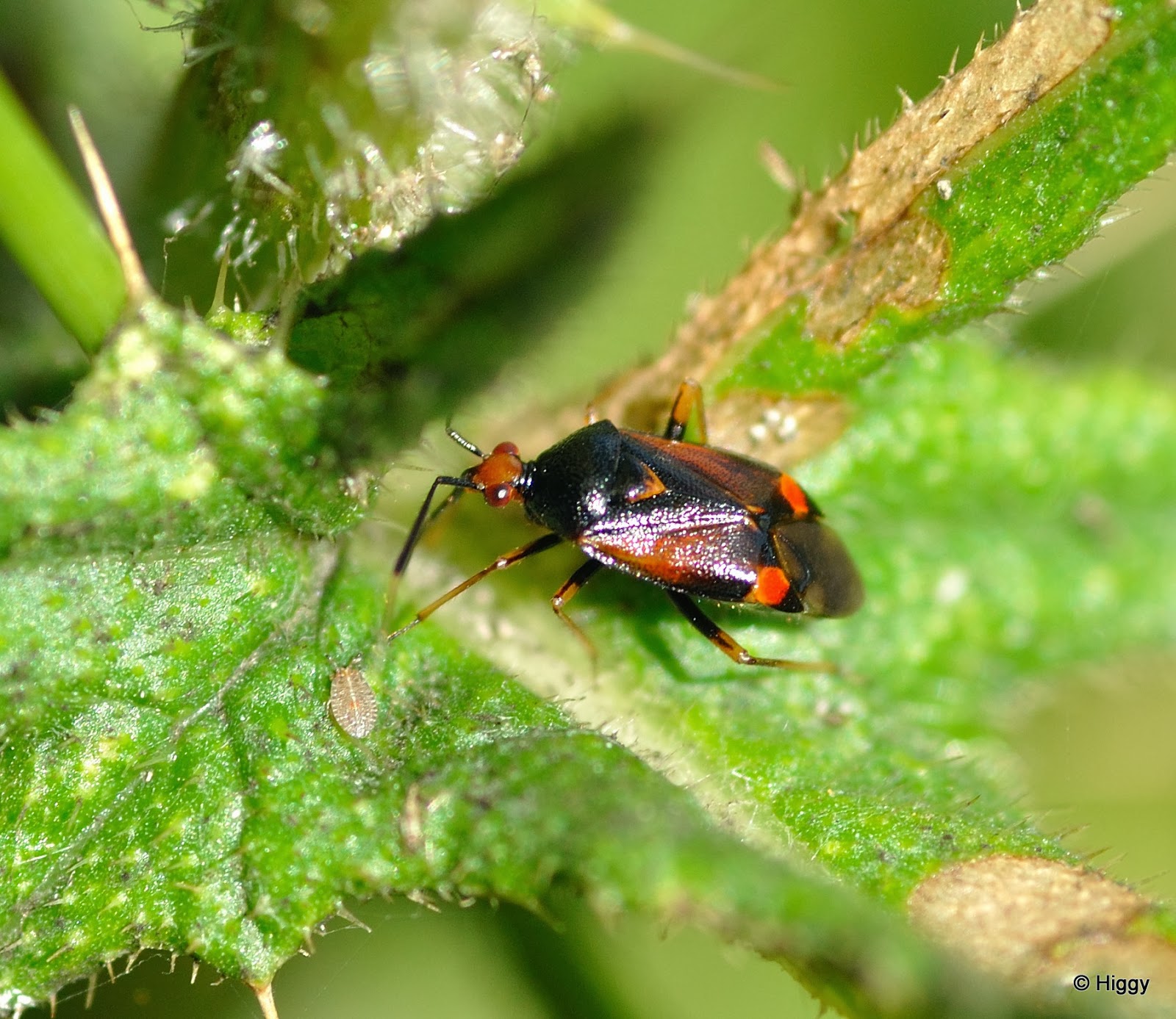
I recorded several new species of flower & leaf beetle during the year including this pretty little Deraeocoris ruber....

Shield Bugs showed well with new species including really good numbers of Forest Bug - Pentatoma rufipes. Not every gardeners delight but more than welcome in the wildlife garden and of course a vital part of the food chain...

The garden butterfly count went up to 20 species with the arrival of the Small Skipper and Marbled White as shown below....

Above is only a small selection of the many new species that we recorded but hopefully demonstrates the benefits of gardening for wildlife and the success that we are now experiencing here.

The other thing that is worth a mention is the very successful moth trapping sessions that we started this summer. These included a large trapping session attended by some of the local wildlife group who all enjoyed not only a great time identifying moths but a cream tea made by my wife! 

Moth trapping in the garden was new for 2013 and proved extremely successful with well over 100 species recorded this summer! Including this impressive Swallow-Tailed Moth - Ourapteryx sambucaria...

A personal favorite for me was definitely two recordings of the gorgeous Hummingbird Hawk Moth - Macroglossum stellatarum. This is a species I have only dreamed of seeing in the garden until now!

I really haven't got room to show every species new this year but I hope the above has at least demonstrated some of the new comers and given you a feel for what we have achieved in 2013 and of course what you could achieve in your own garden.

So with 2013 now at an end we must look forward to 2014 and planning what changes are required to encourage even more wildlife into the garden in the coming year.

I have thought about a lot of things that could be changed but one thing that I keep coming back to is a decent sized wildlife pond with a much bigger body of water. We already have three small ponds and it is often said that several smaller bodies of water are better than one large pond in the wildlife garden! Well I'm taking this one stage further by adding a bigger body of water to my other smaller ponds to try and encourage more and different dragon and damselflies into the garden over the next few years.

It has been a bit a head scratching as to where I could accommodate a bigger pond but with some careful planning I will be putting it alongside the wild flower area. This will mean this area reducing in size somewhat although by careful moving of plants and resowing elsewhere in the garden I think that we can keep the same area of wild flowers if not increase it slightly by spreading it out in different areas of the garden. This is a bit of a trade off but I think that in the long-term it will be well worth it.

So you will have to keep reading the blog to see how this develops but in the mean time I can offer a little taster with a very rough sketch of what I hope it will look like once complete...

I apologise for the look of this sketch I promise my 6yr old daughter didn't do it ! LOL Hopefully it gives a guide of what mad idea is currently in my head and what is planned for 2014...

My thoughts put down on paper for how I want the new wildlife pond feature to look and how I hope it fits seamlessly into the rest of the garden....

My thoughts for this pond feature is that it will be dug down into the ground and my wild flower planting will run right up to the edge of it to help it sit naturally into the site. Already in the wild flower area is an amount of Cuckoo Flower and Ragged Robin that will love the dampness this feature should provide and help to blur the border between land and water! Other planting will include Irises for dragon fly nymphs to climb up and hatch out on, whilst the flowers of many are loved by bumble bees. I also have a large amount of Purple Loosetrife cuttings that will add height, colour and structure at the rear of the pond and into the pollinator planting bed. 

Landscaping wise I plan to build a false stone retaining wall at the side of the dry gravel river bed. This will be complete with an old rusty water sluice to give it a connection to the dry river bed and help it sit more naturally in the garden.

That's the plan for 2014 and a look back at a successful year in the wildlife garden so I bid you a happy New Year and lots of wildlife watching and gardening for 2014!!

Best wishes

Higgy